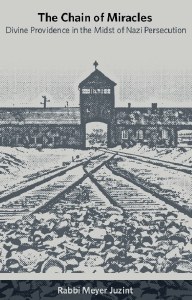
The Chain Of Miracles
$19.99
The Chain of Miracles is an auto-biographical account by Holocaust survivor, author and Talmudist Rabbi Meyer Juzint whose voice will, I hope, remain a vital memory of Holocaust reality in a world in which those who survived are becoming fewer with each passing day. There will soon be a generation of children for whom the Holocaust will be no more than another history lesson. If that is to be the case, let it be Rabbi Juzint's voice in The Chain of Miracles to which they will listen.
A gifted nineteen-year old rabbinical student at the famed Slobodka Yeshiva at the time of the German invasion of Lithuania, young Meyer Juzint and his fellow students, following the advice of their rosh yeshiva, fled when news of the proximity of the invading German armies made it dangerous for them to stay behind.
Guiding his hand for four interminable years, The Almighty provided Meyer with bits and pieces of discarded paper on which to record the miracle of his survival in what we now call "real time".
Rabbi Juzint was both witness and victim of the ghastly determination with which the Nazis and their Lithuanian collaborators afflicted him along with hundreds of other terrorized, homeless Jews caught between the deadly danger of returning to Nazi-occupied Slobodka and the countryside controlled by armed and alcohol-crazed Jew-hating Lithuanian partisans.
His short chapters are exceedingly powerful accounts of mankind at its worst and best.
I had to take extended breaks between them to digest the author's raw narration of Nazi criminality and resolve some historical/existential dilemmas that have troubled me for years.
How could the land which bore so many cultural giants in the Age of Enlightenment become a nation of murderers abetted by their silent accomplices? It seems to be, even now some sixty-seven years after the end of World War II, an unanswerable question,a real conundrum.
However, one can answer it satisfactorily but by first acknowledging that nearly every human being is capable of such gratuitous violence and murder. Whether children including infants, the elderly and sick, women and men makes little or no difference.This truth does not exonerate the guilty for the decision to restrain one's evil inclination or unleash it is entirely a matter for the exercise of our free will.
"I could have done many of these same things," remarked Professor Dan Porat, a Hebrew University professor and author of The Boy, A Holocaust Story, in response to my query about the inherently moral dilemma of Nazi cruelty. His candor stunned me.
Did the Nazis behave inhumanly? No, they did not. Did they behave inhumanely as an expression of their free will? Yes, but only to someone whose moral code derives from knowledge of right and wrong or has been exposed to such teachings in his earlier years.
Additionally, their innate sense of right and wrong had been erased by SS training for which heavy alcohol consumption served as both quieter and enabler. Although sadistic cruelty terrorizes victims into a state of frozen passivity, it cannot but have a psychological effect upon the perpetrator as well. Simon Wiesenthal, intrepid post-War "Nazi hunter", documents the phenomenon in The Sunflower.
Rabbi Juzint arrived in Chicago after the war. Over the course of the next fifty years,1950-2000, he devoted himself to thousands of Chicago area students at the Hebrew Theological College and Ida Crown Jewish Academy as their beloved rebbe and spiritual mentor.
Readers beware! Rabbi Juzint's stories of his miraculous experiences may cause you to examine the depth of your own well of belief. Spared an ignominious death innumerable times by the kindness of the Almighty and steeled in the fiery furnace of "Hitlerite" murder, Meyer Juzint survived a reign of terror which in its breadth and depth far exceeded the mayhem and murder of the Chliemnicki pogroms of 1648-1650.
The author ends narrative with an account of his liberation from Bergen-Belsen that will leave you exhausted, breathless and utterly stupefied by the putrefaction of the perpetrator's human heart on the one hand and the author's unshakable trust and belief in the kindness of The Master of the Universe on the other.
Rabbi Juzint's authorship of The Chain of Miracles was itself miraculous. Kesser Maariv Press has done the world of primary source Holocaust literature an invaluable service by providing readers with this sturdy, hard-bound edition.
I thank the project team of former students of Rabbi Juzint, editors, translators and financial backers whose tireless devotion infused the breath of life into this long overdue project.
A gifted nineteen-year old rabbinical student at the famed Slobodka Yeshiva at the time of the German invasion of Lithuania, young Meyer Juzint and his fellow students, following the advice of their rosh yeshiva, fled when news of the proximity of the invading German armies made it dangerous for them to stay behind.
Guiding his hand for four interminable years, The Almighty provided Meyer with bits and pieces of discarded paper on which to record the miracle of his survival in what we now call "real time".
Rabbi Juzint was both witness and victim of the ghastly determination with which the Nazis and their Lithuanian collaborators afflicted him along with hundreds of other terrorized, homeless Jews caught between the deadly danger of returning to Nazi-occupied Slobodka and the countryside controlled by armed and alcohol-crazed Jew-hating Lithuanian partisans.
His short chapters are exceedingly powerful accounts of mankind at its worst and best.
I had to take extended breaks between them to digest the author's raw narration of Nazi criminality and resolve some historical/existential dilemmas that have troubled me for years.
How could the land which bore so many cultural giants in the Age of Enlightenment become a nation of murderers abetted by their silent accomplices? It seems to be, even now some sixty-seven years after the end of World War II, an unanswerable question,a real conundrum.
However, one can answer it satisfactorily but by first acknowledging that nearly every human being is capable of such gratuitous violence and murder. Whether children including infants, the elderly and sick, women and men makes little or no difference.This truth does not exonerate the guilty for the decision to restrain one's evil inclination or unleash it is entirely a matter for the exercise of our free will.
"I could have done many of these same things," remarked Professor Dan Porat, a Hebrew University professor and author of The Boy, A Holocaust Story, in response to my query about the inherently moral dilemma of Nazi cruelty. His candor stunned me.
Did the Nazis behave inhumanly? No, they did not. Did they behave inhumanely as an expression of their free will? Yes, but only to someone whose moral code derives from knowledge of right and wrong or has been exposed to such teachings in his earlier years.
Additionally, their innate sense of right and wrong had been erased by SS training for which heavy alcohol consumption served as both quieter and enabler. Although sadistic cruelty terrorizes victims into a state of frozen passivity, it cannot but have a psychological effect upon the perpetrator as well. Simon Wiesenthal, intrepid post-War "Nazi hunter", documents the phenomenon in The Sunflower.
Rabbi Juzint arrived in Chicago after the war. Over the course of the next fifty years,1950-2000, he devoted himself to thousands of Chicago area students at the Hebrew Theological College and Ida Crown Jewish Academy as their beloved rebbe and spiritual mentor.
Readers beware! Rabbi Juzint's stories of his miraculous experiences may cause you to examine the depth of your own well of belief. Spared an ignominious death innumerable times by the kindness of the Almighty and steeled in the fiery furnace of "Hitlerite" murder, Meyer Juzint survived a reign of terror which in its breadth and depth far exceeded the mayhem and murder of the Chliemnicki pogroms of 1648-1650.
The author ends narrative with an account of his liberation from Bergen-Belsen that will leave you exhausted, breathless and utterly stupefied by the putrefaction of the perpetrator's human heart on the one hand and the author's unshakable trust and belief in the kindness of The Master of the Universe on the other.
Rabbi Juzint's authorship of The Chain of Miracles was itself miraculous. Kesser Maariv Press has done the world of primary source Holocaust literature an invaluable service by providing readers with this sturdy, hard-bound edition.
I thank the project team of former students of Rabbi Juzint, editors, translators and financial backers whose tireless devotion infused the breath of life into this long overdue project.
Customer Reviews
This product has not yet been reviewed.
Share:
Share on Facebook Share on Twitter Share on Pinterest